Bats
Helpful Bat Resources
Frequently Asked Questions
Rabies is a virus that attacks the brain and nervous system. Without prompt medical treatment after exposure, rabies is almost always fatal. All warm-blooded animals - including humans - can get rabies.
Contact with infected bats is the leading cause of human rabies deaths in this country; at least 7 out of 10 people who die from rabies in the United States were infected by bats. Within Flathead County, bats are the main concern for rabies.
First, you need to find out if the bat may have exposed any humans or animals inside the home. Exposures can occur from handling the bat, sleeping in the same room as a bat or leaving a child, pet, or an intoxicated or mentally disabled individual in a room where the bat was found or could have been.
If there was no exposure to any pets or humans, then the bat can be released outside. If an exposure did occur, the bat should be captured, euthanized and then brought into the Flathead City County Health Department so our staff can send it in for rabies testing.
If a pet is found playing with a bat, you'll need to do a few things.
- Capture the bat so that it can be collected for testing, please see our guide on capturing a bat for detailed instructions on how to safely secure the bat. Always wear protective clothing and gloves while doing this. Never handle a bat with bare hands.
- Reach out to FCCHD at 406-751-8117 so our team can walk you through the process of bringing the bat in for testing. We only send specimens out for testing Monday - Thursday. If you find a bat on Friday, Saturday or Sunday, it will need to be euthanized and stored within a refrigerator. Do not freeze the bat.
- If there was an exposure to a pet, reach out to your veterinarian to discuss a rabies booster for your pet. All pets need to be vaccinated within 96 hours of their exposure. If you or your vet has questions, please reach out to our team at 406-751-8117.
Please call our communicable disease team at 406-751-8117 so that we can go over your specific scenario and help you to determine whether testing of the animal/bat can be done, or if anyone in the household may need follow up treatment.
Please see our instructions on how to safely capture a bat. Once you have caught the bat, please see this guide for instructions on how you can euthanize the bat before bringing it to the health department.
Flathead City County Health Department asks that no live animals are brought to the health department to reduce the likelihood of additional human exposures.
- We can test wild animals for rabies if there is a concern that they may have exposed a pet or human to rabies. To do this, the animal must be dead before being brought into FCCHD.
- If the animal is already dead, please contact the communicable disease program at 406-751-8117 to report the exposure and receive instructions. Afterwards, you will be instructed to drop off the deceased animal at an agreed upon time to FCCHD in a leak-proof bag (such as a large garbage bag) and container. Make sure that no damage is done to the head and neck of the animal. Testing may not be possible if damage has occurred to the head or neck.
- If the animal is still alive you can reach out to animal control at 406-758-5610. If you decide to dispatch the animal yourself, you must not damage the head or neck of the animal.
If the bat hasnt exposed a pet or human, then it can be discarded. Never handle a bat with bare hands. If you choose to move and/or dispose of the body, make sure to wear thick gloves and use a tool, such as a shovel, to do so.
If the bat is in a location where a pet may have been able to touch the body, reach out to the health department at 406-751-8117 and we can walk you through the process of bringing in the bat for rabies testing.
If the bat or wild animal can be brought in for testing, then treatment can be delayed until the results have returned. If testing is not available our team can walk you through the treatment options. For bites or exposures that occur from bats we always recommend that rabies post-exposure prophylaxis (PEP) be pursued if the bat is not available for testing. For more information on PEP, please see this PDF.
Bat bites are extremely small and may not hurt when they occur. The image below shows the size of the wound left from a bat bite.
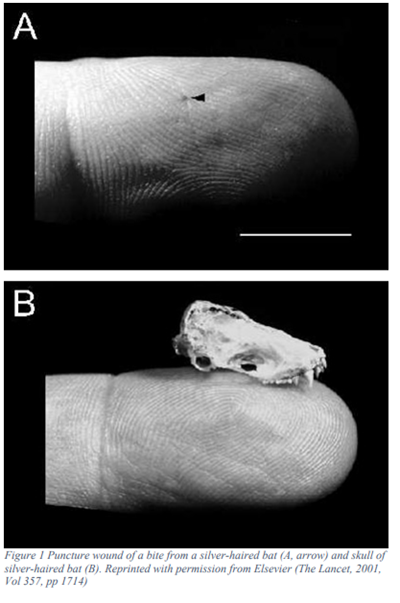
Example of a Bat Bite
Page Last Updated: Jul 22, 2026